
Dollar and Sense: The Financial Forecast
Money isn't just currency; it's a language. Dive deep into its nuances, where strategy meets intuition in the vast sea of finance.
DADemo Author
Feb 24
While achieving 100% test coverage sounds ideal, rarely practical. The goal of a QA engineer is not to test everything, but to test smartly
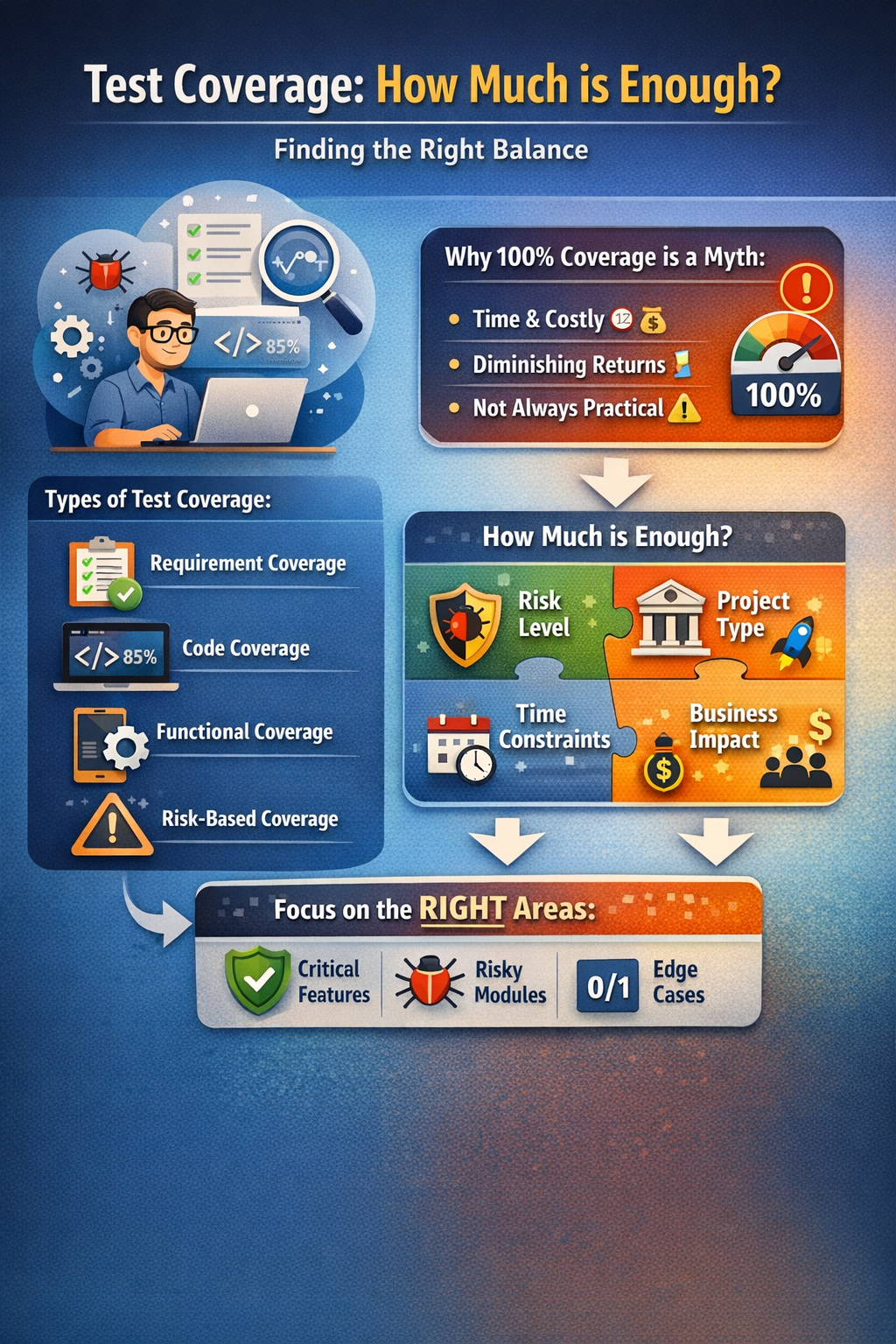
Test coverage refers to the extent to which your testing validates the application’s functionality, code, and requirements.
It answers questions like:
Have all features been tested?
Are critical paths covered?
Have edge cases been considered?
Ensures all business requirements are tested
Helps confirm nothing is missed
👉 Example:
Every user story has at least one test case
Measures how much code is executed during testing
Common metrics:
Line coverage
Branch coverage
Path coverage
⚠️ Important: High code coverage ≠ bug-free software
Validates all system functionalities
Focuses on user workflows
Prioritizes testing based on risk areas
Critical features get more attention
Trying to achieve 100% coverage can lead to:
⏱️ Wasted time on low-risk areas
💸 Increased cost
🔁 Diminishing returns
👉 Example:
Testing every possible input combination in a form is often unrealistic.
The right amount depends on:
High-risk features → High coverage
Low-risk features → Moderate coverage
Banking / Healthcare → Very high coverage
Startup / MVP → Balanced coverage
Tight deadlines → Focus on critical paths
Features affecting revenue or users → Must be thoroughly tested
Instead of chasing 100%, follow this strategy:
Login
Payment
Core workflows
Focus on:
Frequently used features
Complex logic areas
Past defect-prone modules
Automate repetitive tests
Manually explore edge cases
Use metrics as a guide—not a goal.
Invalid inputs
Boundary values
Unexpected user behavior
❌ Focusing only on code coverage
❌ Ignoring edge cases
❌ Testing everything equally
❌ Skipping risk analysis
100% test coverage is not always necessary
Focus on risk, impact, and critical functionality
Use coverage metrics as a guide, not a goal
Smart testing is more valuable than exhaustive testing
Test coverage is not about testing everything—it’s about testing the right things effectively.
A skilled QA engineer understands that quality comes from strategy, not quantity.
So next time you’re asked:
👉 “How much testing is enough?”
You’ll know the answer:
👉 “Enough to confidently reduce risk and ensure quality.”
Money isn't just currency; it's a language. Dive deep into its nuances, where strategy meets intuition in the vast sea of finance.

Explore the untold and overlooked. A magnified view into the corners of the world, where every story deserves its spotlight.

Dive into the marvels of modern innovation, where the only constant is change. A journey where pixels and data converge to craft the future.